
Foreign bloggers capture China's everyday sense of safety
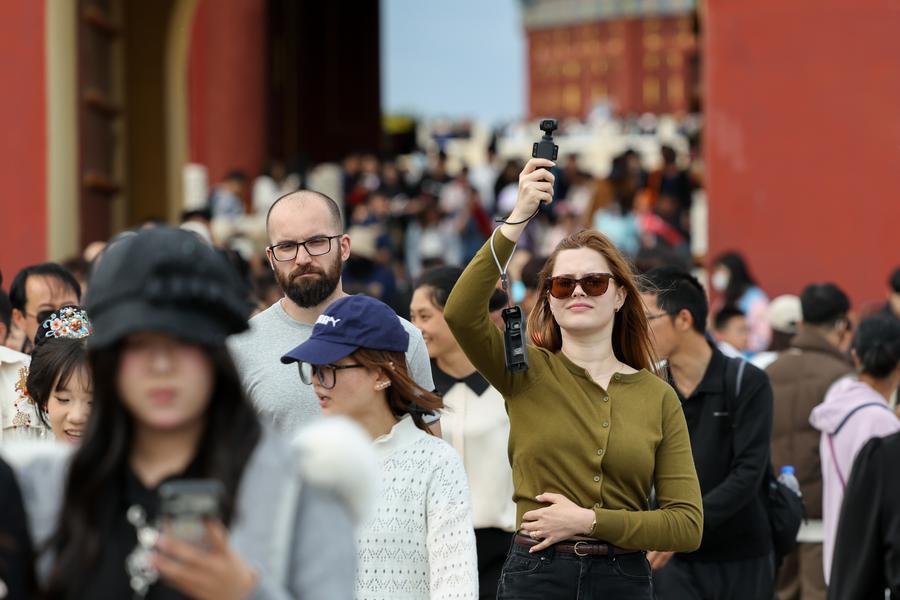
A foreign tourist records with a Chinese-brand pocket camera at the Temple of Heaven Park in Beijing, capital of China, May 2, 2026. (Xinhua/Ju Huanzong)
BEIJING, June 7 (Xinhua) -- "At night in China, my biggest concern going out is that there are simply too many tasty snacks at the night market -- the danger of putting on weight."
With a laugh, 31-year-old Tatiana Kucherova, originally from Russia, summed up what she calls the real risk of living in Guiyang, capital city of southwest China's Guizhou Province.
Tatiana arrived in Guiyang in 2016 to study Chinese at Guizhou University. She later completed a master's degree, found a job and decided to settle in this city.
"Guiyang is a great place to live," she said. "The pace of life is comfortable, and the nightlife is vibrant."
She and her husband frequently head out for late-night barbecue meals, while evenings with friends often end at local bars. What still impresses her most, however, is the sense of safety.
"In bars here, I can leave my belongings on the table without worrying that anyone would take them," she said. "That gives me tremendous peace of mind."
Tatiana regularly shares photos and videos of Guizhou Province on social media. "Seeing the posts, many of my friends abroad added the destination to their travel checklists," she said.
Similar stories have become common among international visitors across China. As international travel to China continues to grow in popularity, fueled by expanded visa-free policies, upgraded inbound travel services and improved all-around public facilities, many foreign travelers are discovering a level of safety that allows them to explore freely.
Via photos and videos, they are increasingly active in sharing the everyday scenes they have come across in China: shop owners napping peacefully at roadside stores, unattended suitcases left untouched in public spaces, and the freedom to head out alone at night without concern.
Ana, a Spanish student studying in Beijing, recently brought three friends on their first trips to China. The group spent their days taking photos in busy commercial districts in Shanghai in east China without worrying about their belongings.
"I feel completely relaxed here," Ana said. "Even walking alone late at night doesn't make me nervous."
What may seem routine to many Chinese residents addresses what is a core concern for many international travelers -- safety. For visitors, the ability to wander through an unfamiliar place freely, day or night, without feeling the need to stay on guard, would be seen as a luxury in many other places in the world.
There were times when many visitors sought safety tips before traveling to China, which might have included keeping bags tightly secured, hiding valuables or avoiding nighttime outings. Yet some quickly found such precautions unnecessary after spending time in China.
French blogger Leo recently left his backpack on a bench at Shanghai's Bund waterfront. When he returned about 30 minutes later, it was still exactly where he had left it. His video documenting the story attracted millions of views overseas.
An Italian content creator who posts online under the alias Carlo Wu has expressed similar feelings. After four years living in Shanghai, he still marvels at unattended parcels left outside apartment doors and laptops sitting untouched in public spaces.
What impressed him even more was the kindness of strangers. After a food delivery was mistakenly sent to a neighbor's apartment, the neighbor personally brought the meal to his door, concerned that he might otherwise go hungry.
Visitors' experiences are reflected in both official statistics and international surveys. According to China's Ministry of Public Security, criminal cases nationwide fell by 12.8 percent in 2025, reaching the lowest level this century. Meanwhile, Gallup's 2025 Global Safety Report ranked China as the third-safest place globally and fourth in the law and order index.
Behind this safe environment lie China's long-term efforts to ensure public security through a well-established legal framework, community-based governance, modern technology, and rapid police response.
China has built a high-level public security network that protects everyone, said Kong Fanbin, dean of Nanjing University's Huazhi Institute for Global Governance.
He emphasized that the network extended beyond formal law enforcement. "Public security here is not maintained by police alone. Community and other grassroots forces also play an important role."
In China, public security has long been a priority for both central and local governments, which regard it as a core public service, noted He Yanling, a professor at the School of Public Administration and Policy, Renmin University of China. "Grassroots governance is also a 'miracle,'" she added.
At a deeper level, observers also attribute the safe environment to China's long-term social stability, sustained investment in public welfare, and its commitment to peaceful development.
(责任编辑:聚焦)
- 中国选手包揽亚运会跳水女子1米跳板金银牌
- 韩国留学研究生有哪些专业
- 加拿大本科和硕士的留学费用离别是多少
- 艺术设计学生的竞赛奖项规划:线上科研项目的路径选择
- 乒乓球德甲第六轮:樊振东独得两分 杜塞尔多夫豪取六连胜
- 首次电视辩论后,特朗普和哈里斯都觉得自己赢了
- 羽毛球世锦赛:中国三对双打组合闯入决赛
- 澳新留学院校资讯盘点(4月14日)
- (爱知·名古屋亚运会)中国体育代表团秘书长:前半程中国队成绩符合预期
- 拯救“秃顶”的大气层|国际臭氧层保护日
- 拯救“秃顶”的大气层|国际臭氧层保护日
- 加拿大音乐学院研究生录取条件
- 以总理:将对迪拜航空航班遇袭事件幕后主使进行报复
- 教育部原党组副书记、副部长杜玉波接受审查调查