
Xinhua Commentary: Why "de
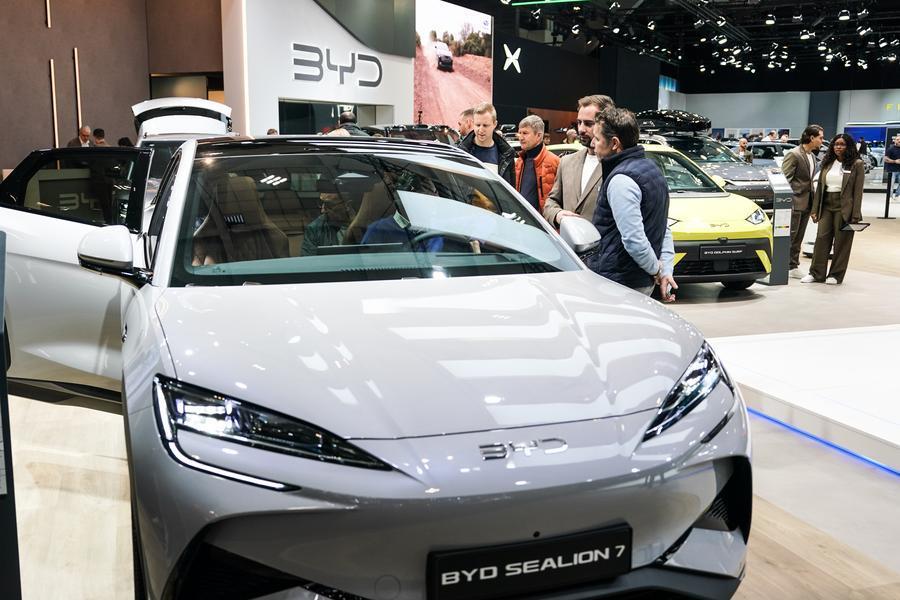
People view a BYD car during the Brussels Motor Show in Brussels, Belgium, Jan. 10, 2026.
(Xinhua/Peng Ziyang)
BEIJING, June 11 (Xinhua) -- Recent vociferous talk and highly targeted policies under discussion by the European Union (EU) have cast a shadow over the bloc's economic and trade relationship with China, precisely at a time when steady bilateral cooperation is urgently needed amid global uncertainties.
In late May, EU commissioners described the current state of the bloc's trade and investment relationship with China as "not sustainable." The European Commission said its "overarching approach remains de-risking, not decoupling."
Simultaneously, the EU's proposed Industrial Accelerator Act will subject Chinese investors to discrimination in violation of basic market economy principles such as voluntary participation in commercial activities and fair competition, and distort the level playing field in the EU market.
Against such official EU assessments and policy positioning, a comprehensive view of China-EU economic and trade relations helps clarify the essence of the issue.
It is true that the EU has registered a goods trade deficit with China in recent years. However, it has long maintained a sizable surplus with China in service trade.
According to Chinese statistics, China's deficit in service trade with the EU reached 48.3 billion U.S. dollars in 2025. The EU was the largest source of China's service trade deficit, accounting for 41.6 percent of China's total service trade deficit.
Given the comparative advantages of various economies and the international division of labor, it is common and normal for one economy to have a trade surplus with some partners and a trade deficit with others. What matters is the overall trade balance.
As a matter of fact, the EU has seen a big trade surplus in recent years. In 2025, the EU's trade in goods balance registered a surplus of 128 billion euros (147.84 billion U.S. dollars). In 2024, the EU trade in services balance reached 194 billion euros, the highest figure in the past decade.
China has never deliberately pursued a trade surplus. In terms of China-EU trade, some facts should be taken into account. Firstly, a significant share of China-EU trade is generated by European companies operating in China. Secondly, high-quality and competitively priced Chinese products help ease inflationary pressures in Europe and reduce the cost of living for consumers there. Thirdly, around half of China's exports to Europe consist of intermediate goods, which help European companies considerably reduce the production costs of finished products and effectively enhance the competitiveness of EU exports in global markets. In addition, EU export controls on high-tech products to China have constrained the EU's export potential in the Chinese market.
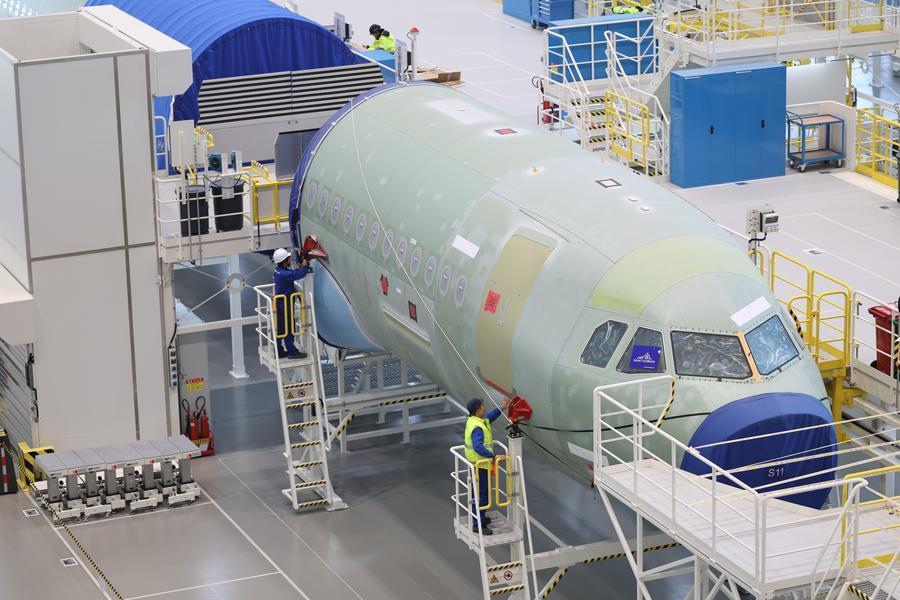
Staff members work at Airbus' second A320 family final assembly line in Tianjin, north China, Nov. 17, 2025. (Airbus/Handout via Xinhua)
The essence of China-EU economic and trade relations lies in complementarity and mutual benefit. In 2025, China and the EU were each other's second-largest trading partners, with total trade reaching 828 billion U.S. dollars, up 5.4 percent year on year.
Given the large scale and broad scope of China-EU economic and trade relations, differences and frictions are inevitable. The key is to properly address them through dialogue and consultation in line with the important consensus reached by the leaders of both sides.
In seeking to reduce "dependence" on an important partner, the EU risks undermining its own competitiveness and long-term economic growth. Any substantial moves aimed at "de-risking" from China would entail significant costs for Europe and harm the interests of its consumers and enterprises.
A "de-risking" strategy would almost inevitably lead to stricter scrutiny of cross-border investment, raising compliance costs and discouraging Chinese companies from investing in the EU.
Meanwhile, any arbitrary or unilateral measures would be tantamount to contravening WTO principles and disrupting global supply chains. Such an approach could also intensify internal differences within the bloc.
If the EU insists on imposing economic and trade restrictions on China, China will have to take countermeasures to safeguard its legitimate interests. It would be advisable for European policymakers to carefully consider the potential consequences before adopting restrictive and discriminatory policies targeting Chinese enterprises.
China has always viewed and developed China-EU relations from a strategic and long-term perspective. The high-quality development and high-standard opening up of the world's second-largest economy will create new cooperation opportunities for the EU, rather than posing risks to the bloc.
Communication channels between China and the EU remain open. It is hoped that the EU could honor its commitment to free trade, and work with China in the same direction to properly manage differences through constructive dialogue and consultation for the sake of the stable and sound development of bilateral relations.
(责任编辑:娱趣)
- 西安表态:深挖彻查、绝不姑息
- 一张图:2026年4月15日黄金原油外汇股指“枢纽点+多空持仓信号”一览
- 福利来袭!COD现代战争4 单人战役推出提前体验通道
- 粉色康乃馨和粉色满天星搭配好看吗?粉色康乃馨和粉色满天星的搭配图片
- 贵州黔西市游船倾覆事故最后一名失联人员被找到
- 福利来袭!COD现代战争4 单人战役推出提前体验通道
- 11朵玫瑰花代表什么意思?不同颜色代表的含义不同,适合送花对象也不同!
- 货运增长660多倍!石家庄如何变身“国际陆港”?
- 能源冲击下全球央行紧缩潮在重启
- 跳出经典特工框架!荒诞话术为007打造别样特工风格
- 日本民间团体人士:必须阻止日本强军扩武进程
- 一张图:2026年4月15日黄金原油外汇股指“枢纽点+多空持仓信号”一览
- 俄中选委:执政党在俄国家杜马选举中领先
- 女儿没结婚,搬新家,妈妈送什么花好?