
Xinhua Commentary: Why "de
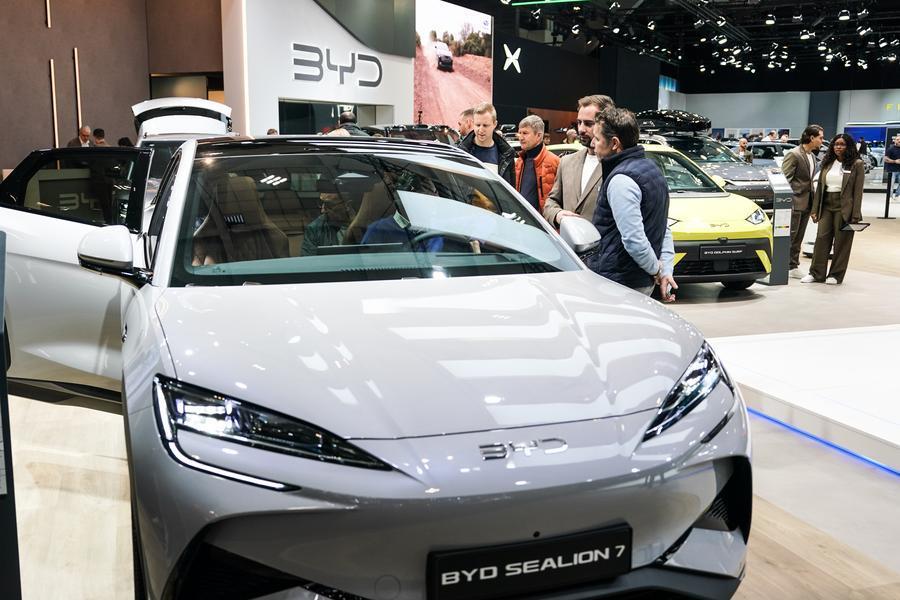
People view a BYD car during the Brussels Motor Show in Brussels, Belgium, Jan. 10, 2026.
(Xinhua/Peng Ziyang)
BEIJING, June 11 (Xinhua) -- Recent vociferous talk and highly targeted policies under discussion by the European Union (EU) have cast a shadow over the bloc's economic and trade relationship with China, precisely at a time when steady bilateral cooperation is urgently needed amid global uncertainties.
In late May, EU commissioners described the current state of the bloc's trade and investment relationship with China as "not sustainable." The European Commission said its "overarching approach remains de-risking, not decoupling."
Simultaneously, the EU's proposed Industrial Accelerator Act will subject Chinese investors to discrimination in violation of basic market economy principles such as voluntary participation in commercial activities and fair competition, and distort the level playing field in the EU market.
Against such official EU assessments and policy positioning, a comprehensive view of China-EU economic and trade relations helps clarify the essence of the issue.
It is true that the EU has registered a goods trade deficit with China in recent years. However, it has long maintained a sizable surplus with China in service trade.
According to Chinese statistics, China's deficit in service trade with the EU reached 48.3 billion U.S. dollars in 2025. The EU was the largest source of China's service trade deficit, accounting for 41.6 percent of China's total service trade deficit.
Given the comparative advantages of various economies and the international division of labor, it is common and normal for one economy to have a trade surplus with some partners and a trade deficit with others. What matters is the overall trade balance.
As a matter of fact, the EU has seen a big trade surplus in recent years. In 2025, the EU's trade in goods balance registered a surplus of 128 billion euros (147.84 billion U.S. dollars). In 2024, the EU trade in services balance reached 194 billion euros, the highest figure in the past decade.
China has never deliberately pursued a trade surplus. In terms of China-EU trade, some facts should be taken into account. Firstly, a significant share of China-EU trade is generated by European companies operating in China. Secondly, high-quality and competitively priced Chinese products help ease inflationary pressures in Europe and reduce the cost of living for consumers there. Thirdly, around half of China's exports to Europe consist of intermediate goods, which help European companies considerably reduce the production costs of finished products and effectively enhance the competitiveness of EU exports in global markets. In addition, EU export controls on high-tech products to China have constrained the EU's export potential in the Chinese market.
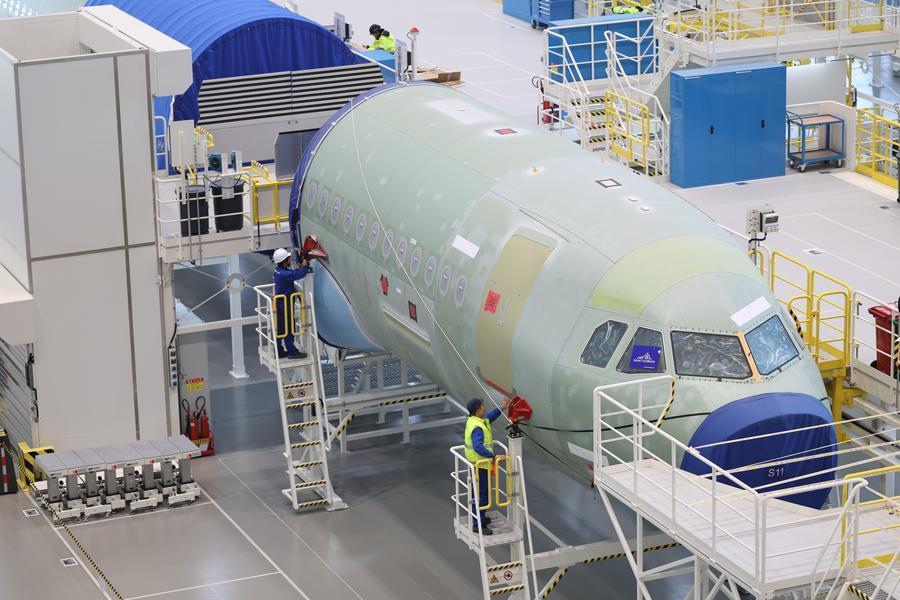
Staff members work at Airbus' second A320 family final assembly line in Tianjin, north China, Nov. 17, 2025. (Airbus/Handout via Xinhua)
The essence of China-EU economic and trade relations lies in complementarity and mutual benefit. In 2025, China and the EU were each other's second-largest trading partners, with total trade reaching 828 billion U.S. dollars, up 5.4 percent year on year.
Given the large scale and broad scope of China-EU economic and trade relations, differences and frictions are inevitable. The key is to properly address them through dialogue and consultation in line with the important consensus reached by the leaders of both sides.
In seeking to reduce "dependence" on an important partner, the EU risks undermining its own competitiveness and long-term economic growth. Any substantial moves aimed at "de-risking" from China would entail significant costs for Europe and harm the interests of its consumers and enterprises.
A "de-risking" strategy would almost inevitably lead to stricter scrutiny of cross-border investment, raising compliance costs and discouraging Chinese companies from investing in the EU.
Meanwhile, any arbitrary or unilateral measures would be tantamount to contravening WTO principles and disrupting global supply chains. Such an approach could also intensify internal differences within the bloc.
If the EU insists on imposing economic and trade restrictions on China, China will have to take countermeasures to safeguard its legitimate interests. It would be advisable for European policymakers to carefully consider the potential consequences before adopting restrictive and discriminatory policies targeting Chinese enterprises.
China has always viewed and developed China-EU relations from a strategic and long-term perspective. The high-quality development and high-standard opening up of the world's second-largest economy will create new cooperation opportunities for the EU, rather than posing risks to the bloc.
Communication channels between China and the EU remain open. It is hoped that the EU could honor its commitment to free trade, and work with China in the same direction to properly manage differences through constructive dialogue and consultation for the sake of the stable and sound development of bilateral relations.
(责任编辑:娱趣)
- 2026年“愉悦垒球进社区、进校园”大连站活动举行
- 全球连线|美国各界人士期盼美中关系回到康健稳定发展轨道
- 深耕生命秘境,解锁科学无限可能——哈佛大学生物专业的学术魅力
- 嘉鱼农民金玉明4首“长江情歌” 唱尽簰洲湾28年变迁
- 宁夏贺兰山东麓半程马拉松金秋赛9月26日开跑
- 刚刚公布!这道高考题,没有标准答案
- 江苏苏州:5932米!太仓港完成最后一块“拼图”,引领苏州智造奔赴“海上丝路”!
- 艺术类留学:给热爱艺术的孩子,一条更开阔的成长路
- 美联储鹰派信号压制黄金涨势,黄金维持区间震荡
- 特朗普全国讲话,扬言两到三周内终结伊朗威胁,原油应声暴涨近6%
- 特朗普想速战速决击垮伊朗,海湾国家恐被拖入长期险境
- 前日本人气女星滨崎真绪月薪3.4万招小编:要求会中文
- (爱知·名古屋亚运会)亚运会男足小组赛:中国队首战逆转朝鲜队
- 快递新规实施一周年 湖北包裹的“绿色变形记”