
Xinhua Headlines: Young people from Taiwan trace roots across Strait, build future on mainland
* Young people from Taiwan have shared their stories of tracing roots and pursuing dreams on the mainland at the ongoing 18th Straits Forum in east China's Fujian.
* Despite the Democratic Progressive Party authorities' increasing restrictions, young people in Taiwan call for broader cross-Strait exchange and integrated development.
* More young people have come to see the mainland as the place for pursuing their dreams and building a better future, aware of its comprehensive industrial system and vast market opportunities.
XIAMEN, June 15 (Xinhua) -- After finally arriving at their ancestral village, Wu Ping-chang watched his father stand in the ancestral hall, his lips tight, silently tracing the engraved names belonging to members of their shared lineage.
"We sat with the villagers, who share the same surname as us, enjoying tea, chatting in a similar accent. It's a wonderful bond that comes from our common roots," said Wu, from Tainan in southern Taiwan, whose ancestors migrated from Fujian on the mainland, like many other families on the island.
This reunion was made possible by a chance encounter last year -- one that Wu's father and grandfather had dreamed of for decades.
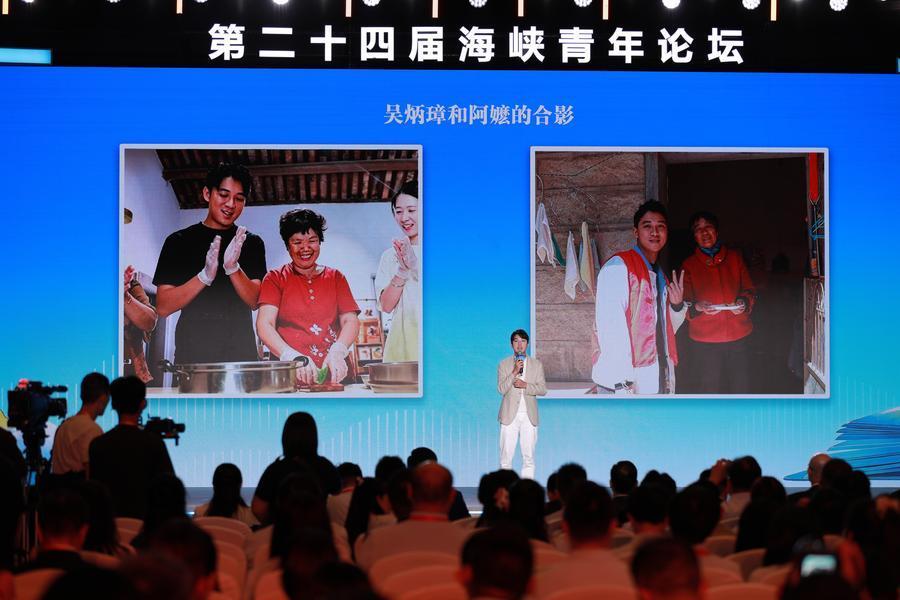
Wu Ping-chang shares his stories during the 24th Straits Youth Forum in Xiamen, east China's Fujian Province, June 12, 2026. (Xinhua/Chen Wang)
TRACE ROOTS
In 2025, after working in Fujian for several years, Wu happened to become part of the organizing team for a cross-Strait sporting event in the province's Jinjiang. While having a chat with local colleagues, he brought up his family's struggle to trace their roots and the limited information they possessed, including a hazy recollection of a town name and a genealogy book that had been handed down through the generations.
With clues provided by his colleagues, they quickly discovered a village in Jinjiang that might be the young man's ancestral home. After repeatedly visiting local elders and examining historical records in the village, he eventually found names in the village's Wu clan genealogy that matched those in his family's genealogy book.
"When I finally found my family's roots, I just realized that I had already put down roots of my own here, on this land," Wu said, sharing his story at one of the panel sessions of the ongoing 18th Straits Forum in Fujian.
Held annually since 2009 as the largest grassroots exchange event across the Strait, the Forum this year includes 15 exchange activities for young people in fields such as e-commerce, sports, new media and education, with a goal of supporting young people from Taiwan to study and work on the mainland.
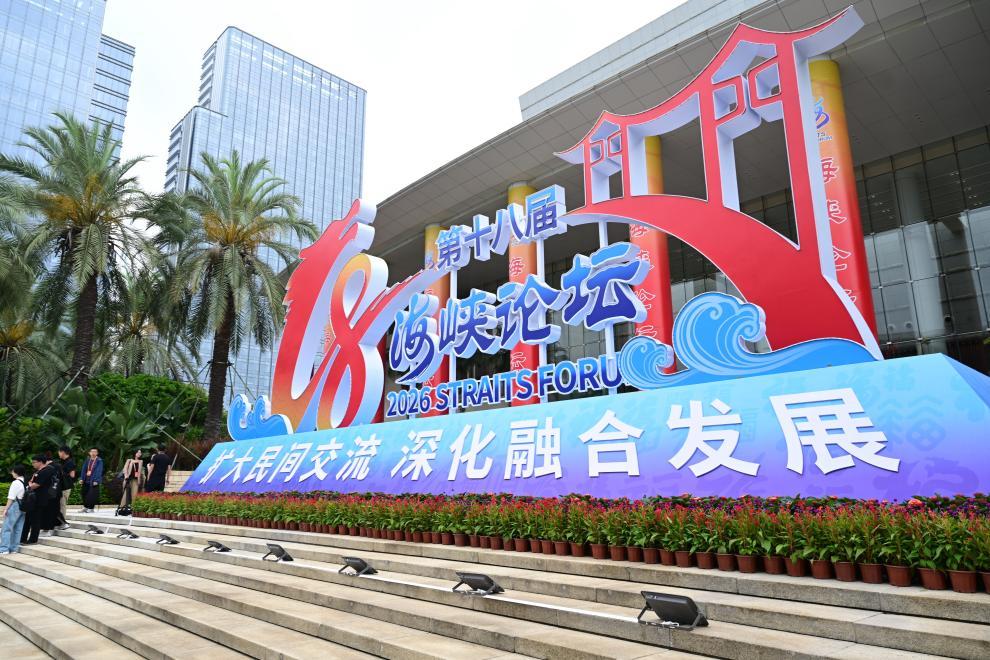
The 18th Straits Forum is held in Xiamen, southeast China's Fujian Province, June 13, 2026. (Xinhua/Lin Shanchuan)
In 2020, Wu settled in a suburban town in Xiamen, Fujian, starting his career in rural revitalization and innovation. It's a cross-Strait program that provides financial support to architects and cultural and creative professionals from Taiwan to help revitalize villages, improve living environments, and develop local cultural and tourism industries.
Over the last five years, the Fujian government has invested more than 680 million yuan (about 100 million U.S. dollars) to help Taiwan young people take part in this program. According to data from the provincial government, there are 190 such rural revitalization teams from Taiwan working in Fujian.
Over the past six years, Wu's team has expanded its model of rural revitalization and cultural industry development to multiple villages in Fujian, and also established its own platform to support innovative projects.
"I hope that more young people from across the Strait find their roots and have a home in Fujian villages," he said.
PRESERVE BOND
Despite the two sides of the Strait left in a prolonged state of political confrontation by unresolved civil war and foreign interference, the blood ties that underpin many Taiwan people's identification with the Chinese nation and Chinese culture have never died.
For Liao Chia-hsing from Taiwan, what has been passed down in the family is not about searching for the other end of a cross-Strait bond, but about preserving it.
Liao's grandfather carried a bowl with him when the troops retreated to Taiwan in 1949 as part of the remnants of the Chinese Kuomintang party following its defeat in the civil war. He was settled in one of the military dependents' villages built as temporary housing for millions of relocated soldiers and their dependents. The temporary arrangement became permanent, and he would not see his hometown again for decades.
"Sometimes he would just hold the bowl and stare at it," Liao recalled. After cross-Strait travel gradually resumed from the end of the 20th century, his grandfather finally had the chance to revisit his hometown. By then, only one of his sisters remained there. After returning to Taiwan, the old man continued to cherish the bowl as a treasured reminder of home until his passing.
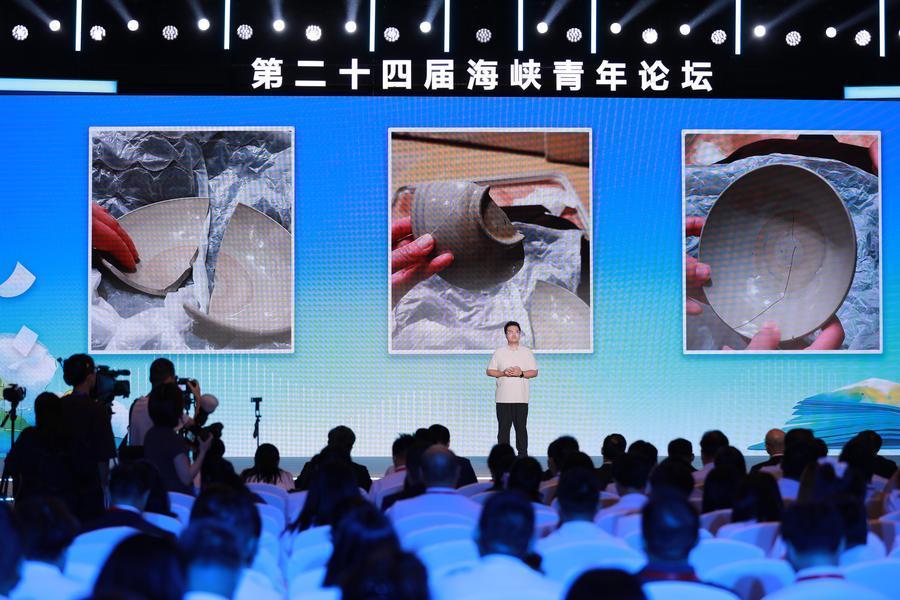
Liao Chia-hsing shares his stories during the 24th Straits Youth Forum in Xiamen, east China's Fujian Province, June 12, 2026. (Xinhua/Chen Wang)
"I later realized that what he cherished was not just the bowl itself, but the longing and attachment it carried throughout his lifetime," Liao said.
Due to his grandfather's influence, Liao developed an interest in mainland life. During his time in college, he made multiple trips across the Strait to volunteer as a rural teacher on the mainland. In 2018, he chose to settle in the southwestern city of Chengdu.
Eight years later, Liao now runs a childcare facility aimed at connecting childcare concepts from Taiwan with local market demands, while being the father of a young child himself. "I hope to contribute to more cross-Strait cultural exchange and integration through my work," he said.
PURSUE DREAMS
In April, the mainland unveiled a package of 10 policies and measures to promote exchange and cooperation with Taiwan, specifying plans to facilitate the restoration of passenger flights and tourism across the Strait, as well as offering a broader platform for youth exchange.
These measures have been welcomed by young people on both sides of the Strait. Meanwhile, the Democratic Progressive Party authorities' increasing restrictions on normal cross-Strait exchanges have drawn growing criticism for undermining industries, employment opportunities and livelihoods in Taiwan.
A recent poll in Taiwan has indicated growing support for reunification among people in their twenties. At the same time, more people have come to see the mainland as the place for pursuing their dreams and building a better future, aware of its comprehensive industrial system and vast market opportunities.
Lo Shih-ming, from Taipei, describes himself as "a child raised by both sides of the Taiwan Strait," with his father starting an abalone farming-related business on the mainland in 1996.
Lo himself, who earned a bachelor's degree in computer science from Xiamen University, has turned to marine aquaculture as well, but only with a more modern approach than his father.
In 2020, Lo participated in the design of Mintou No. 1, Fujian's first independently developed deep-sea aquaculture platform. In 2023, he started his own business in Xiamen in the field of deep-sea aquaculture.
This year, Lo's company has secured a sea area in Ningde, Fujian, a major hub for large yellow croaker production, for their own farming of this prized fish species.
Lo expressed optimism that his company's first batch of large yellow croakers would sell well in Taiwan. "I hope that more people on the island can enjoy the fresh and high-quality seafood produced on the mainland," he said.
For Chris Lai, co-founder and CEO of biotech firm METiS TechBio, the entrepreneurial journey on the mainland started in 2019 in east China's metropolis of Hangzhou. His team won second prize in an entrepreneurship competition organized by the city government, receiving more than 10 million yuan of funding support, which came with almost no additional conditions.
"We are determined to make the project a success," said Lai, who graduated from Taiwan University and later earned a Ph.D. at the Massachusetts Institute of Technology.
The city government provided extensive assistance, such as rent-free facilities and help with business registration. "I truly felt that this was a city willing to trust young people and to give dreams the time and space they need to grow," Lai said while sharing his experience at the main conference of the Straits Forum over the weekend.
Based on the mainland's comprehensive innovation ecosystem, METiS TechBio has developed rapidly with a focus on AI-driven drug delivery. In May this year, it debuted on the Hong Kong Stock Exchange.
"The mainland offers genuine opportunities, supportive policies and a welcoming environment for young people from Taiwan," Lai said.
"You can find your stage to realize your potential as long as you are willing to stay grounded and combine your professional expertise with the strengths of local industries," he said. Enditem
(Video reporters: Mi Yingting, Lin Kai; video editors: Zhang Yucheng, Roger Lott, Luo Hui, Zhang Ning) ■
(责任编辑:探知)
- 台军无人机被曝用大陆产品“贴牌”,否认后被打脸
- 《生化危机:维罗妮卡》重制落地!对标生化4重制品质
- 国内首个!武汉朗来科技1类创新药盐酸兰诺可泮片获批上市
- 中留服:这十一种情况学历认证不再受理!
- 韩国清州大学3+1即将开始申请,专业选择渊博,录取友善!
- 亿缕阳光·乡见|麦浪翻金夏收忙
- US farmers 'cautiously optimistic' on China trade
- 世界杯韩国队首胜!韩国体育名校国民大学本科招生中!高考后新选择,无语言可申请
- 一张图:2026年9月18日黄金原油外汇股指“枢纽点+多空持仓信号”一览
- Foreigners' shopping lists evolving
- 2026夏日游戏节汇总:古剑、生化维罗妮卡RE、剑星新作!
- 一张图看商品支撑阻力:金银油气+铂钯铜农产品期货(2026年5月21日)
- 30小时、3天、 30天,3年俄乌僵局能否在伊斯坦布尔打破?
- 无需高端显卡!《古墓丽影》新作最低只需GTX1070起步